
Blog · 9 November 2026 · 5 min read
Flat Tyre Near Me: Can You Drive To A Shop, Or Should You Stop?
How to tell whether a flat tyre can take any more driving, what a run-flat does and does not change, what to send so a van can come with the right tyre, and when it can be repaired rather than replaced.
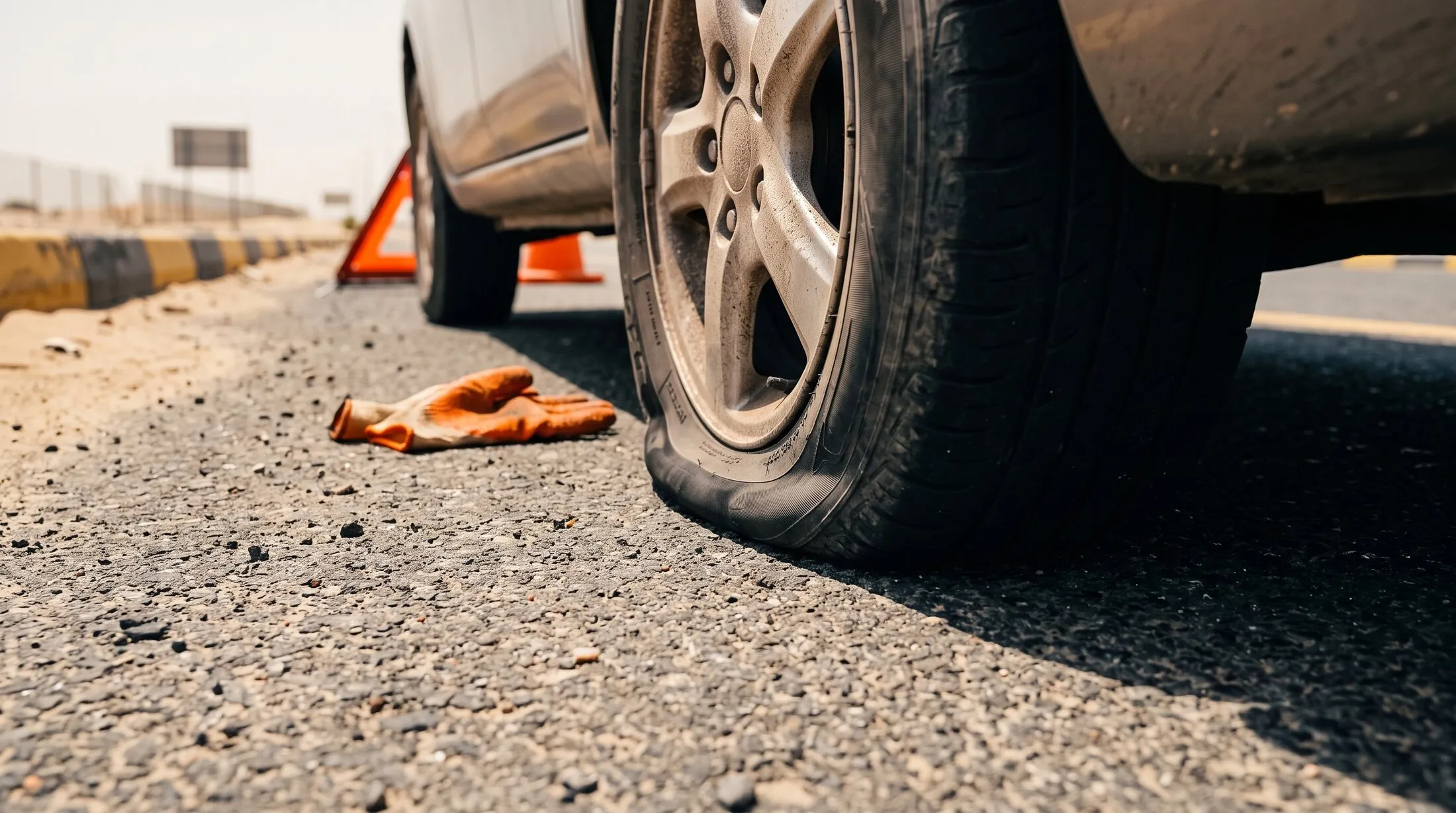
"Flat tyre near me" is a search typed standing next to the car, and under it sits one decision: drive to the nearest shop, or stay where you are and have the shop come to you? The honest answer is stay, with one narrow exception. This post is how to tell which side of the line you are on, what a run-flat does and does not change, and what to have ready if you stay. If you are on a motorway right now, read the first five minutes on Sheikh Zayed Road first and come back.
Flat, or just soft?
Look at the tyre before you decide anything. A tyre that is losing air slowly still looks like a tyre: the sidewall holds its shape and the car drives normally. A flat tyre sags onto the rim, the car pulls to one side, and you may hear the flap that gave it away. The pressure warning light on a newer car is no help in deciding: it only comes on when a tyre is well below its target, so it is a last warning, not a first one.
- Losing air slowly, still holding its shape: drive gently to the nearest safe place to stop. Not across the city to a shop, and not onto Sheikh Zayed Road to look for one; a slow puncture can become a fast one when a nail shifts at speed.
- Visibly soft, pulling to one side, or already flat: do not drive on it.
The one drive a flat tyre is allowed
There is a single good reason to move a car on a flat tyre, and it is not a shop. It is to get out of danger: off a live lane and onto the hard shoulder, a service road, a forecourt or a car park, slowly, with the hazard lights on. Beyond that, every extra few hundred metres on a flat usually destroys the tyre and can damage the rim, which turns a repair into a replacement. On a hot day a flat driven for a few kilometres can shred completely.
The shop that looks close on the map is not the cost. What you destroy on the way to it is. A stopped car in a safe bay costs you waiting time; a car driven on a flat to a shop costs you waiting time and usually a tyre.
What about run-flat tyres?
A run-flat is built so the car can keep moving for a limited distance, at reduced speed, after it loses pressure. How far and how fast is set by the tyre maker and the carmaker and printed in your owner's handbook; it differs from tyre to tyre, so we do not quote a figure and you should not rely on one you read online.
Two practical points. A run-flat can be hard to spot by looking, so the pressure warning light may be your first sign; when it comes on, treat the allowance as a way to reach somewhere safe, not as a reason to carry on with your day. And the catch is in our repair or replace post: most manufacturers say a run-flat that has been driven on while deflated should be replaced, and so do we. The allowance buys you mobility, not a repairable tyre. If you can stop and call, the tyre has a better chance.
Spare, sealant or nothing
Many newer cars and SUVs sold in the UAE carry no spare at all, only a sealant kit and a small compressor. If you do have a spare, check its pressure before you trust it: most of the ones we see have sat for years at half pressure, and a space-saver spare is limited to around 80 km/h for a short distance. If you are not confident changing a wheel on a hard shoulder, do not; that is the one place where a mistake is dangerous. Sealant will get you to safety, but it coats the inside of the tyre, has to be cleaned out before a proper repair, and can ruin the pressure sensor in the wheel. Use it when you have to, not as a repair.
If you can see a nail or screw in the tyre, leave it where it is. It is plugging the hole. Pulling it out empties the tyre in seconds and makes the hole harder to find. More in a nail in your tyre: what to do.
What the mobile service needs from you
Four things, and with them we quote a fixed price before the van moves. That is the price.
- Where you are. A live location on WhatsApp is best. On a motorway, the nearest exit number and the direction you are travelling do the job.
- The tyre size. It is on the sidewall as a line like 225/55 R18. Send a photo rather than reading it out; the letters matter and a photo removes the guesswork. Our post on reading your tyre size shows where to look.
- A photo of the damage. A nail or screw in the tread, a cut, a bulge, or simply the whole tyre lying flat. If you cannot see a cause, tell us what happened: a slow leak over a week and a blowout are different jobs.
- Where the car is standing. A villa driveway, an office car park, a mall basement and a hard shoulder are all fine, but say which: a basement needs a van that fits under the barrier, and a hard shoulder changes how we park.
Arrival is usually about twenty minutes from the call, at any hour of the day or night; traffic and your exact spot decide the rest, and we tell you honestly when you call.
Plug or replace?
We decide at the car, with the tyre off the rim and its inside in view, on four things: where the damage is, how big it is, how much tread is left, and how old the tyre is and whether it was driven flat. A nail or screw hole in the tread, up to about 6 mm, on a tyre with healthy tread is repaired properly from the inside with a plug-and-patch, which is permanent and costs less than a new tyre. Damage in the sidewall or the shoulder cannot be repaired safely by anyone, and a large cut or a tyre that has been driven flat usually means a replacement too.
If you sent the size, we bring a matching tyre, so a puncture that cannot be repaired is still fixed on the first visit and the old tyre goes with us. A string plug from a roadside kit is a get-you-to-safety fix, not a repair; we check it and do a proper inside repair if the tyre qualifies. And if you have already driven on the flat, say so when you call. It changes the answer, and it is better to hear that before the van sets off than after.
Cars and SUVs only
We repair and fit tyres on cars and SUVs, including the large ones. We do not do trucks, buses or trailers; if that is what you have, we say so on the phone rather than send a van that cannot help.
Flat right now? The flat tyre near me page has the number and the WhatsApp link. If it is the middle of the night and you are wondering what is even open, this post covers it.